Hamilton has two distinct personalities separated by one of the most dramatic geological features in southern Ontario: the Niagara Escarpment. On one side, the suburban, family-oriented Mountain. On the other, the urban, walkable downtown core. Both are great places to live — but they offer fundamentally different lifestyles. This guide breaks down exactly what to expect from each, so you can make a confident decision about where your family belongs.
The Niagara Escarpment — Hamilton's "Scar"
To understand Hamilton, you first have to understand the geology. The Niagara Escarpment is a massive ridge of rock that runs right through the city — a 400-million-year-old formation created from ancient seabed deposits of limestone and dolostone, later shaped by glacial activity during the last Ice Age. It's part of a UNESCO Biosphere Reserve that stretches from Niagara Falls all the way to Tobermory.
In Hamilton, the escarpment creates a dramatic natural divide. It splits the city into two distinct levels: the Mountain (above the escarpment) and the lower city (below it). Hamiltonians casually call it "the Scar," and it's visible everywhere — dramatic cliff faces, waterfalls pouring over the edge, and green trails winding along the top. You're never far from it, no matter where you live.
Why the Escarpment Matters for Living
- The Mountain offers newer suburban developments (mostly 1970s–present), family-friendly neighbourhoods, bigger lots, and easier highway access via the Lincoln Alexander Parkway and Red Hill Valley Parkway.
- The lower city has more character, walkability, older heritage homes, the downtown core, and direct access to the GO Station.
- Commuting between them takes just minutes via the Jolley Cut, Kenilworth Access, James Mountain Road, or the Red Hill Valley Parkway — they're connected by several easy routes.
- Environmental protection: The escarpment is protected by the Niagara Escarpment Plan — no building on the face, and greenbelt protection on both sides. This means the views and trails are permanent.
The escarpment isn't just a geographic curiosity — it shapes daily life in Hamilton. Mountain residents tend to drive more and rely on suburban infrastructure. Lower-city residents walk more and gravitate toward urban amenities. Both sides have access to the Bruce Trail, dozens of waterfalls, and some of the best hiking in southern Ontario. The Scar is Hamilton's greatest natural asset, and it's the reason this city feels so different from anywhere else in the GTA.
At a Glance: Mountain vs Downtown
| Factor | Mountain | Downtown / Lower City |
|---|---|---|
| Character | Suburban, newer (1970s–present) | Urban, historic (1800s–mid-1900s) |
| Avg. Home Price | $650K–$850K | $500K–$750K (varies widely by pocket) |
| Walkability | Low–Moderate | High |
| Lot Sizes | Generous suburban lots | Compact urban lots |
| Schools | Many newer options, growing fast | Established, strong community ties |
| Shopping | Malls, big-box retail, plazas | Indie shops, galleries, cafés |
| Food & Culture | Suburban mix, chain restaurants | Exceptional — galleries, Art Crawl, waterfront dining |
| Transit | Bus service, car-dependent | GO Station, future LRT, walkable |
| Commute to Toronto | 60–80 min drive; GO from mountain bus | 70 min GO direct from Hamilton GO Centre |
| Highway Access | Excellent — Hwy 403, 6, Linc, RHVP | Good — direct to 403 and QEW |
| Nature | Sam Lawrence Park, Bruce Trail, golf | Waterfront Trail, Bayfront, Pier 4 |
| Community Feel | Growing suburban, diverse | Tight-knit urban, vibrant arts scene |
| Best For | Families wanting space & schools | Young professionals, creatives, commuters |
Living on the Mountain
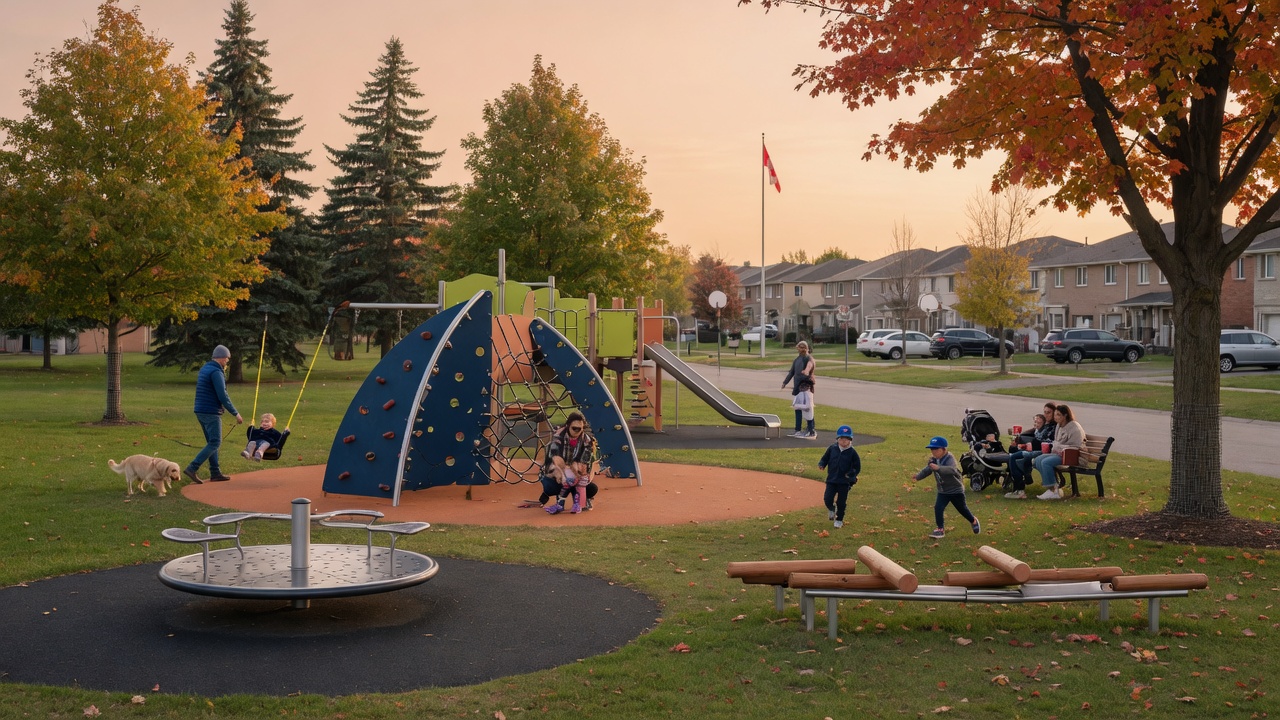
The Hamilton Mountain is where most families end up — and for good reason. It offers the suburban infrastructure that makes raising kids easier: wider streets, bigger lots, newer schools, and shopping plazas with everything you need within a short drive. The Mountain grew rapidly from the 1970s onward, and today it's home to some of Hamilton's most diverse and family-oriented communities.
Housing & Neighbourhoods
The Mountain's housing stock is predominantly post-1970s suburban: split-levels, back-splits, two-storey detached homes, and townhome developments. You'll find wider streets, driveways, garages, and backyards — the classic suburban package. Newer developments in Binbrook and the Upper Stoney Creek area offer modern builds with open-concept layouts. Established pockets on the Central and East Mountain have mature trees and renovated family homes.
Explore all neighbourhoodsSchools
Many newer Catholic and public schools, growing fast with the population. The Mountain has strong options across public, Catholic, French Immersion, and secular French-language streams. Corpus Christi Catholic Elementary has scored a perfect 10/10 on the Fraser Institute Report Card. Schools like Ancaster Meadow, Mountview Public, and Cardinal Heights are consistently well-rated. The key is applying early — especially for French Immersion and Catholic school boundaries.
Read the full Schools GuideShopping & Amenities
The Mountain has Hamilton's major shopping centres: Eastgate Square, Centre Mall, and LimeRidge Mall. Big-box retail along Upper James and Upper Wellington gives you Costco, Home Depot, Walmart, and major grocery stores all within minutes. It's the suburban convenience factor — you can run all your errands in one trip without parallel parking on a narrow street.
Commute & Access
Quick access to the Red Hill Valley Parkway, Lincoln Alexander Parkway, and Highways 403 and 6. Easy drive to Burlington, Oakville, and Mississauga — the west GTA corridor is very accessible from the Mountain. If you work in Mississauga or Oakville, living on the Mountain can actually be faster than living downtown Hamilton.
Nature & Outdoors
Sam Lawrence Park offers stunning escarpment views. The Bruce Trail runs along the top of the escarpment with multiple access points. Chedoke Golf Course, community gardens, and the Waterfalls Trail system are all right here. The Mountain's proximity to the escarpment means you're never more than a few minutes from a trailhead or a waterfall.
See all parks & trailsCommunity Feel
Growing rapidly, with active community associations and increasingly diverse neighbourhoods. The Mountain has a strong sense of community — families know their neighbours, kids play on cul-de-sacs, and community events draw crowds. It's not as "exciting" as downtown, but for families, that's often the point.
Living Downtown / Lower City
Downtown Hamilton and the surrounding lower-city neighbourhoods are in the middle of a genuine renaissance. If you value walkability, character homes, arts and culture, and urban energy, the lower city offers something the Mountain simply can't match. It's not for everyone — but for the right person, it's unbeatable.
Character & Architecture
The lower city is urban, walkable, and full of older character homes — Victorian, Edwardian, and early 20th-century builds on tree-lined, established streets. The architecture is one of the biggest draws: high ceilings, original woodwork, bay windows, and front porches that define the neighbourhood feel. In areas like Durand, Corktown, Strathcona, and the Locke Street corridor, you'll find some of the most charming residential streets in southern Ontario.
Culture & Food
James Street North has become Hamilton's cultural hub — galleries, restaurants, cafés, and the famous monthly Art Crawl. International Village on King Street is a multicultural dining destination. The waterfront at Pier 8 is a major revitalization project with restaurants, events, and public spaces. FirstOntario Concert Hall and Hamilton Place anchor the entertainment scene. The food and arts scene in downtown Hamilton rivals cities twice its size.
Transit & Commute
Walkable to the Hamilton GO Centre at 126 James Street South — direct GO Transit service to Union Station in about 70 minutes. The Hamilton LRT (Light Rail Transit) is also under development, which will connect the east end to the west end through downtown and up the Mountain. For anyone who commutes to Toronto, the lower city's proximity to the GO Station is a major advantage.
Walkability & Lifestyle
Hamilton Waterfront Trail, Bayfront Park, Pier 4 Park, and the Dundurn Castle grounds are all accessible from the lower city. You can walk to a café, a restaurant, a gallery, and a park without getting in the car. The neighbourhoods of Durand, Corktown, Stinson, and the Locke Street area have tight-knit urban communities with a vibrant, diverse feel.
Price Considerations
Renovated character homes in desirable lower-city pockets (Durand, Corktown, Strathcona, Locke Street area) can command premium prices — often higher than comparable homes on the Mountain. But unrenovated homes and emerging neighbourhoods like the International Village area offer relative value. The lower city's housing stock is more varied, so there's a wider price range.
Downtown Hamilton — What You Should Know
If you're seriously considering downtown, there are a few things that residents and visitors should understand about how the core actually works day-to-day.
Heritage Buildings & Architecture
Downtown Hamilton has one of the best collections of Victorian, Edwardian, and early 20th-century architecture in Ontario. James Street South, King Street East, and the International Village area are full of heritage buildings, many dating back to the late 1800s and early 1900s. The city has been actively restoring and repurposing these buildings — old factories becoming loft condos, historic banks becoming restaurants, warehouses becoming artist studios. It's a living, working heritage district, not a museum piece.
The One-Way Street System
Downtown Hamilton is known for its network of one-way streets. Main Street, King Street, Cannon Street, and Barton Street all run one direction through the core. This was a mid-20th century traffic design choice that's now being reconsidered — there's active discussion about converting some streets back to two-way to slow traffic and improve walkability. For drivers, it means knowing which street goes which way. For residents, it means the downtown core is actually pretty easy to navigate once you learn the pattern.
Revitalization & Growth
James Street North has become Hamilton's cultural hub — galleries, restaurants, cafés, and the famous Art Crawl. International Village on King Street is a multicultural dining destination. The waterfront at Pier 8 is a major revitalization project with restaurants, events, and public spaces. Gore Park, the Centre Mall area, and the Hamilton Public Library Central Branch are all anchors of the downtown core. The energy is real — new businesses open regularly, and the pedestrian traffic on James Street North on a weekend is proof that this area has momentum.
GO Transit & the LRT
Hamilton GO Centre at 126 James Street South connects to Toronto via GO Transit — direct service to Union Station in about 70 minutes. For commuters, this is the single biggest practical advantage of living downtown. The Hamilton LRT (Light Rail Transit) is also under development, which will connect the east end to the west end through downtown and up the Mountain, further improving transit connectivity across the city.
Hospitals in Hamilton
Hamilton has an exceptional concentration of hospitals — two major healthcare networks with multiple campuses, plus specialized facilities. Whether you live on the Mountain or downtown, you're well-served. Here's the full breakdown:
Hamilton Health Sciences (HHS)
The largest hospital network in the region, with multiple campuses across the city.
McMaster University Medical Centre
1200 Main Street West
The flagship campus — home to McMaster Children's Hospital, the Juravinski Cancer Centre research hub, and one of Canada's leading medical research facilities. It's a major teaching hospital affiliated with McMaster University's medical school. Emergency, pediatric specialist care, cancer treatment, and complex surgeries.
Hamilton General Hospital
237 Barton Street East
The region's trauma centre. Emergency, cardiac care, stroke treatment, and major trauma. This is where you go for the most critical emergencies. Located in the lower city, easily accessible from both the Mountain and downtown.
Juravinski Hospital & Cancer Centre
711 Concession Street
Specialized in cancer care, orthopedics, and complex surgeries. The Juravinski Cancer Centre is one of Ontario's major regional cancer treatment facilities. Located on the Mountain, convenient for Mountain residents.
St. Peter's Hospital
88 Maplewood Avenue
Focused on rehabilitation, complex continuing care, and palliative services. Important for families needing long-term care or rehabilitation support.
West Lincoln Memorial Hospital
169 Main Street East, Grimsby
A community hospital on the western edge, closest to west Mountain and Ancaster residents. General emergency and community health services.
St. Joseph's Healthcare Hamilton
A separate Catholic healthcare network with three campuses.
Charlton Campus
50 Charlton Avenue East
Emergency department, mental health services, and general medical care. The main acute-care campus. Located in the lower city, close to the Mountain access points.
West 5th Campus
100 West 5th Street
A state-of-the-art facility dedicated to mental health and addictions care. One of the most modern mental health facilities in the province.
King Campus
2757 King Street East
Outpatient services, rehabilitation, and research. Located on the eastern edge of the city.
Other Healthcare Facilities
Mountain Medical Centre
Walk-in and urgent care conveniently located on the Mountain for non-emergency medical needs.
McMaster Family Practice
100 Main Street West
A family medicine teaching practice affiliated with McMaster University. Accepts new patients and provides comprehensive primary care.
What This Means for You
Both the Mountain and downtown have excellent hospital access. Mountain residents are closer to Juravinski and McMaster. Downtown residents are closer to Hamilton General and St. Joseph's Charlton. In practice, Hamilton is compact enough that any hospital is within a 15–20 minute drive from anywhere in the city.
Getting Between Mountain & Downtown
One of the best things about Hamilton is how quickly you can move between the two levels. The escarpment sounds like a barrier, but the access points make it easy. Here are the main routes:
Jolley Cut
James Street South to Mountain. The most popular and direct route — connects the downtown core to the Central Mountain in minutes.
Kenilworth Access
Kenilworth Avenue to the Mountain. Connects the east end of downtown to the East Mountain.
James Mountain Road
A scenic route with switchbacks. Popular with cyclists and pedestrians in summer. Connects James Street North to the Mountain.
Red Hill Valley Parkway
A major expressway connecting the lower east city to the Mountain and the east end. Fast and efficient, especially during off-peak hours.
Claremont Access
Connects the central lower city to the Mountain. A steep, direct route popular with commuters.
Lincer Boulevard
Connects the west Mountain to the west lower city. Useful for getting to Highway 403 and the west end.
During off-peak hours, crossing the escarpment takes 5–10 minutes. During rush hour, the Jolley Cut and Claremont Access can back up, but alternate routes are usually clear. Many residents who live on the Mountain but work downtown (or vice versa) report that the escarpment crossing is a non-issue in daily life.
The Bottom Line
Choose the Mountain if you want…
- A bigger home with a yard, garage, and driveway
- Proximity to newer schools with strong ratings
- Easy highway access to Burlington, Oakville, Mississauga
- Suburban convenience — big-box shopping, plazas, chain restaurants
- A quieter, more family-oriented daily rhythm
- Proximity to escarpment trails and parks
Choose downtown if you want…
- Walkable streets with cafés, galleries, and restaurants on every block
- Character homes with history and charm
- Easy access to the GO Station for Toronto commutes
- The waterfront, Art Crawl, and a thriving arts scene
- Urban energy and a tight-knit, diverse community
- Future LRT access and ongoing revitalization
My advice: spend a full Saturday in each area. Get coffee on James Street North, walk along the waterfront at Pier 8, then drive through the Mountain neighbourhoods. Stop at Sam Lawrence Park for the escarpment view. Visit LimeRidge Mall. You'll feel the difference immediately — and your gut will tell you where your family belongs.
Not sure whether Mountain or downtown is right for you?
Talk to Tory — she knows every neighbourhood. Book a complimentary planning call and get a personalized recommendation based on your family's needs, budget, and lifestyle.
Continue Reading
What $800K Buys on Hamilton Mountain
Budget breakdown by neighbourhood — what you actually get for your money.
Best Areas for Young Families
Schools, parks, and affordability — ranked for families.
All Neighbourhood Guides
Deep dives into Ancaster, Binbrook, Central Mountain, East Mountain, West Mountain, and Upper Stoney Creek.
Hamilton Mountain School Guide
Public, Catholic, French Immersion, and high school options.