How to Price Your Hamilton Mountain Home to Sell — Not Just to List
By Tory Akene, REALTOR® | Real Broker Ontario Ltd. · · 7 min read
If there's one decision that makes or breaks a home sale, it's the list price. I've seen beautiful Hamilton Mountain homes sit on the market for 70+ days — not because they weren't great houses, but because they were priced wrong from day one. In today's balanced market, pricing your home correctly isn't just important; it's the single biggest factor in whether you sell quickly, sell profitably, or end up chasing the market down with reductions.
Why Overpricing Is the Most Expensive Mistake Sellers Make
I hear the same reasoning from sellers every week: "Let's list a little higher and see if we can get it." I understand the logic — you lose nothing by trying, right? Wrong. You lose quite a lot.
Here's what the data consistently shows: homes that are overpriced by 5–10% sell for less than homes priced accurately from the start. That sounds counterintuitive, but the mechanism is straightforward. An overpriced home generates initial interest when it first hits the market — that first week is when every listing gets the most attention. But when buyers see the price relative to comparable homes, they dismiss it. Showings dry up. The listing goes stale. After 30–40 days, the seller reduces the price — and now the home is marked with the stigma of a price reduction. Buyers assume something must be wrong with it. The final sale price ends up 3–5% lower than it would have been if the home had been priced correctly initially.
On a $750,000 Hamilton Mountain home, that mistake can cost you $22,500 to $37,500. That's real money — enough to cover your closing costs, your staging, and then some.
Source: National Association of REALTORS® pricing studies; Ontario REALTOR® association data on list-to-sale price ratios for overpriced vs. accurately-priced properties.
The Pricing Sweet Spot: Where You Want to Be
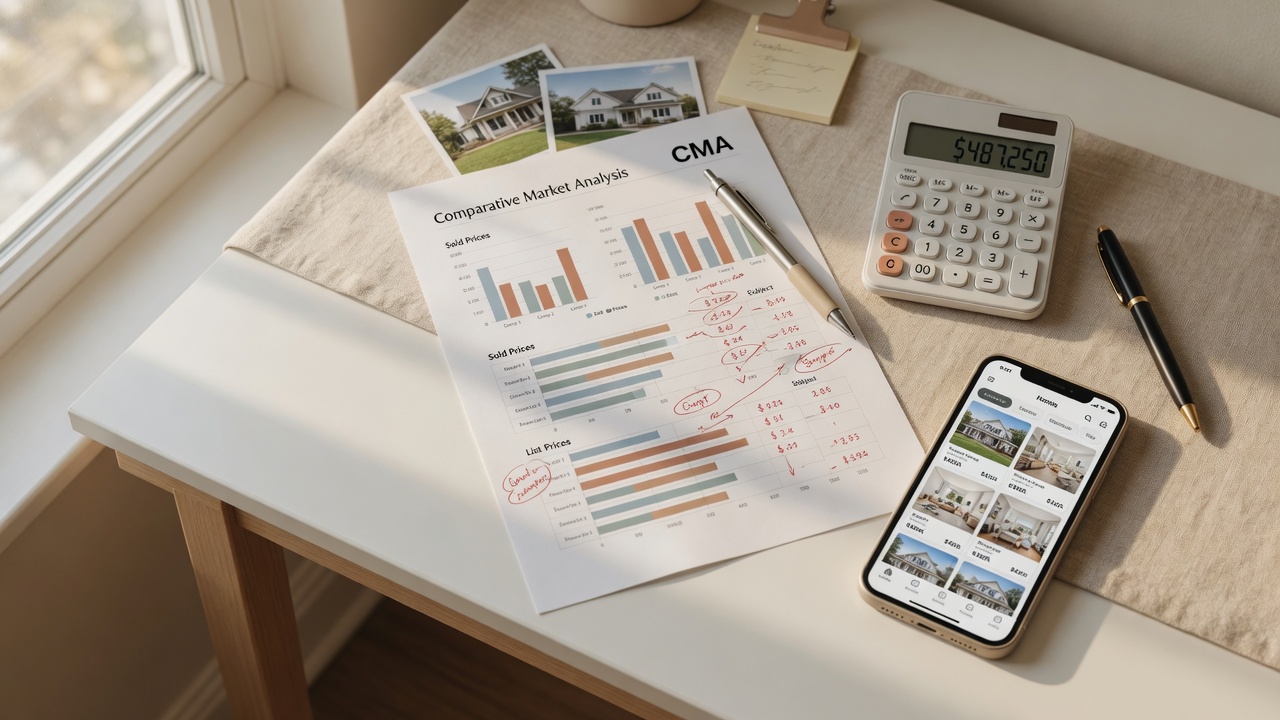
The goal isn't to price low — it's to price accurately. In a balanced market like Hamilton Mountain in summer 2026, the sweet spot is the range where comparable homes have actually sold in the last 60–90 days. Not listed — sold. There's a big difference.
Here's how I determine the right price for a Hamilton Mountain home:
Start with recent comparable sales
I pull every comparable sale within a 1-km radius of your home from the last 60–90 days. Same neighbourhood, same property type, similar size and condition. These are the real anchors for your price — not what your neighbour listed for, but what homes actually closed at.
Adjust for differences
No two homes are identical. I adjust the comparable prices based on differences in square footage, lot size, garage, finished basement, kitchen/bath updates, and overall condition. A renovated home with a finished basement on the same street as an unrenovated one might justify a $40,000–$60,000 premium.
Factor in current market velocity
In today's market, days on market average 39–45 across Hamilton. I look at how quickly comparable homes are selling and where buyer demand is strongest. Homes in the $650K–$800K range on the Mountain are moving faster — which can support a price at the higher end of the comparable range.
Consider the psychological price points
Pricing at $749,900 instead of $755,000 can matter. Many buyers set their search filters at round numbers — $750K, $800K, $900K. Pricing just below a major threshold puts your home in front of more buyers. It's a small tactic, but it can make a meaningful difference in initial traffic.
The "Testing the Market" Trap
This is the most common pricing mistake I see on the Hamilton Mountain, and I want to address it directly because it's tempting. The idea goes like this: "We'll list at $825,000 and if nobody bites, we'll drop it." Here's why that almost never works in your favour:
- The first two weeks matter most. Every listing gets the most traffic in its first 10–14 days. If your price scares off buyers during that window, you've wasted your best opportunity.
- Stale listings signal problems. When a home sits for 50+ days, buyers assume something is wrong with it — even if the only issue is the price. Every additional week on market costs you negotiating leverage.
- Price reductions attract bargain hunters. When you reduce your price, you attract buyers who are specifically looking for deals — not buyers who see the full value of your home. That changes the tone of every negotiation.
- You can only make a first impression once. You don't get a second chance at how buyers perceive your home's value when they first see it online.
Real Example: The Power of Right Pricing
Let me share a scenario I see play out regularly on the Mountain. Two similar 3-bedroom detached homes on the same street, both around 1,600 sq ft, both with finished basements. Home A lists at $739,900 based on a thorough comparable analysis. Home B — the seller's agent suggested $769,000 to "leave room for negotiation." Home A sells in 11 days for $745,000 with two offers. Home B sits for 55 days, receives one offer after a $20,000 price reduction, and closes at $735,000. Home A's seller walked away with $10,000 more and a fraction of the stress.
Pricing competitively doesn't mean leaving money on the table. It means creating the conditions for buyers to compete — and competition is what drives your final sale price up.
What "Pricing to Sell" Actually Looks Like
When I prepare a pricing recommendation, here's what I'm aiming for:
A price within 1–3% of the average comparable sale price for similar homes in your immediate neighbourhood
A price that makes buyers feel they're getting fair value — not a steal, but not overpaying either
A price positioned to attract multiple offers when your home is the best-presented option in its price range
A price that respects your financial needs while acknowledging what the market is actually paying today
Your Pricing Conversation Starts With Data
I never walk into a listing appointment with a number already decided. I come with data — comparable sales, current competition, buyer demand metrics, and a recommended range. Then we talk through your timeline, your financial goals, and your comfort level. The final price is always a collaborative decision, but it's always grounded in what the market is actually doing — not what we wish it were doing.
If you're thinking about selling and want to understand where your home fits in today's market, book a complimentary call. I'll walk you through the comparable sales in your area and give you an honest assessment of what pricing strategy gives you the best outcome.
Thinking about selling your Hamilton Mountain home?
Talk to Tory — she knows every neighbourhood. Get a data-driven pricing recommendation for your specific home.
Book a Free Call