If you've been searching "how much house can I afford in Hamilton Ontario," you're in good company. It's the question I hear at kitchen tables all over the Mountain, usually with two coffees and a phone full of saved listings between us. The answer is never just one number, but here is the good news: once you understand three things, you can name your own budget with confidence. Those three things are the price of the homes you're actually looking at, the down payment you can realistically bring, and the mortgage rules a lender will use to decide how much to approve.
Step 1: What Do Homes Actually Cost in Hamilton Right Now?
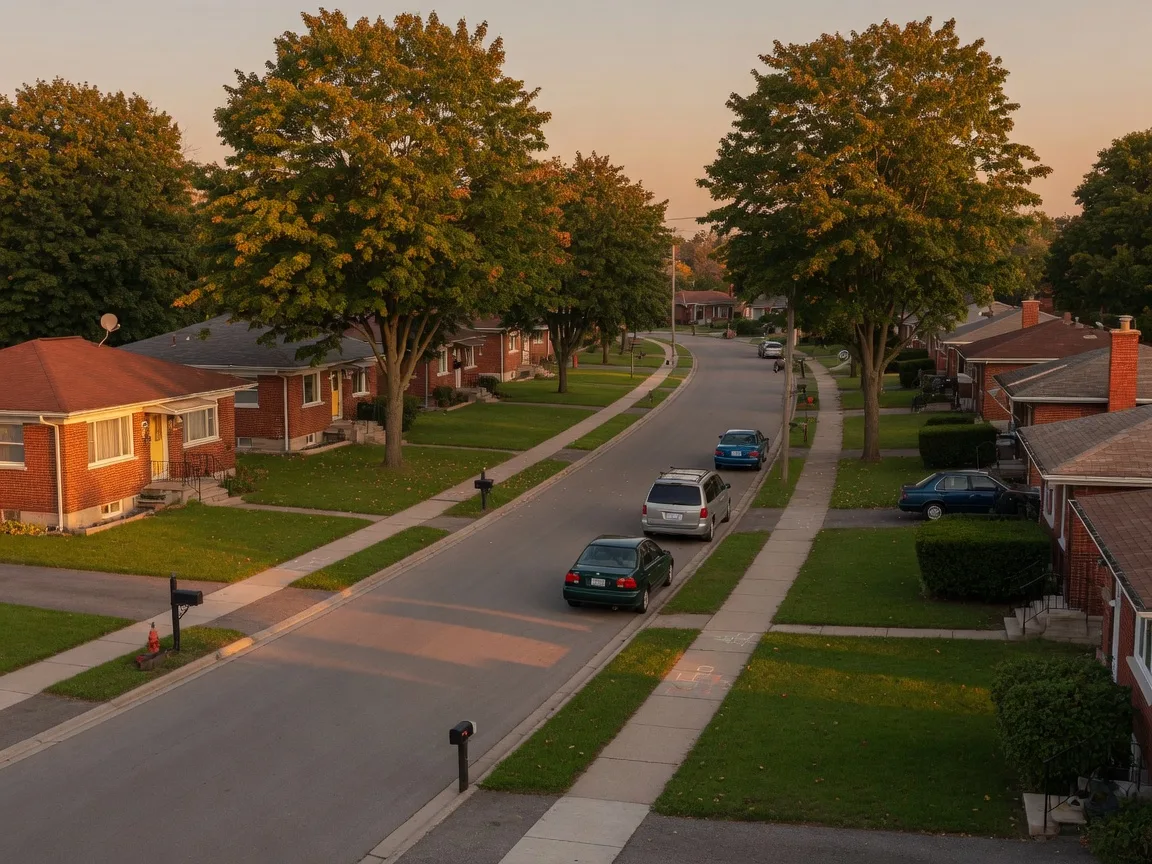
Affordability starts with the price tag, and Hamilton prices have settled into a realistic range. Across the city, the average sold price in July 2026 was approximately $741,172, down about 3.4% from a year earlier. On the Mountain specifically, where brick bungalows and side-splits dominate, detached family homes have been holding near the $717,000 range through mid-2026, and city-wide detached homes averaged $848,891.
In plain terms: most family homes on the Mountain land somewhere between the high $600,000s and the mid-$800,000s, depending on the street, the school catchment, and the kitchen. I keep the numbers current on the monthly market snapshot, and the September 2026 market update has the full breakdown.
Step 2: Down Payments, and Why the Minimum Isn't the Whole Story
Federal rules set a minimum down payment of 5% on the first $500,000 of the purchase price and 10% on the portion above $500,000, up to $1.5 million. Homes of $1.5 million or more require 20%. So on a $700,000 home, the minimum down payment is $45,000, not $70,000, which surprises almost everyone.
Here is what the mortgage calculators don't shout about: put down less than 20% and you pay mortgage default insurance, a premium of roughly 4% of the mortgage at the minimum down payment, added onto your loan. That premium raises your monthly payment, so the classic advice still holds. A bigger down payment gets you a smaller mortgage, no insurance premium, and a payment that gives your family breathing room. New to saving? The down payment guide and the FHSA guide will get you moving.
Step 3: The Mortgage Stress Test Sets Your Real Budget
Lenders don't approve you at today's rate alone; they test you at the higher of your contract rate plus 2% or the 5.25% floor. With five-year fixed rates hovering around 5%, most families are effectively qualifying around the 6.5% to 7% mark. On top of that, your housing costs, mortgage, property tax, and heat, can't exceed about 39% of gross household income, and total debts can't pass 44%.
This is why your "what would I pay" number and your lender's "what we'll approve" number can look different. It's also why getting pre-approved before you tour homes is the smartest move you can make: it converts this whole rules discussion into one number, locked in for 90 to 120 days usually.
Two Real-World Examples for 2026
Example one: a first home at $700,000
With the $45,000 minimum down payment, your mortgage sits near $655,000 plus an insured premium, and the payment lands around $3,900 a month at today's rates over 25 years. Add property tax and heat, and a household income in the $145,000 to $155,000 range keeps you comfortably inside lender guidelines. First-time buyers can also stretch the amortization to 30 years, which trims the payment closer to $3,600.
Example two: a move-up home at $850,000
A family selling a starter home and bringing 20% down, $170,000, skips mortgage insurance entirely. A $680,000 mortgage at roughly 5% over 25 years works out to about $3,950 a month before property tax and heat, which is why so many Mountain families trade up with equity from their first home rather than starting the down payment from scratch.
What About Interest Rates Right Now?
The Bank of Canada held its policy rate at 2.25% on September 2, 2026, the seventh straight hold, which keeps prime lending at 4.45%. Advertised five-year fixed rates are hovering near 5%, with broker-discounted rates sometimes coming in a touch lower. Stable rates mean your budget today is a honest reflection of your budget for the next few years, which is exactly what families should want before making a decision this size.
Frequently Asked Questions
How much house can I afford on a $100,000 salary in Hamilton?
With 20% down and today's rates, a $100,000 household income typically supports a purchase in the $500,000 to $600,000 range once property tax and heat are included. That lands you in entry bungalow and townhome territory on the Mountain, and a second income or a larger down payment moves the number up quickly. A pre-approval gives you the exact figure for your situation.
Should I put 5% down or save for 20%?
Both are legitimate, and the right answer depends on your timeline. Five percent gets you in sooner but adds mortgage insurance and a higher payment; 20% saves thousands in premiums but takes longer to reach. Many Hamilton families split the difference, coming in with 10% or 15%, and I've seen plenty of smart purchases at every point along that spectrum.
Is 2026 a good time to buy in Hamilton?
For many families, yes. Prices have plateaued rather than spiking, inventory gives you choices, and rates have been stable all year, which makes the numbers predictable. There's no guarantee in any market, but the combination of steady prices and stable financing is a genuinely sensible window to buy on the Mountain.
Does the stress test apply to every mortgage?
It applies to mortgages from federally regulated lenders, which covers the banks and most brokers. A very small number of alternative and private lenders sit outside those rules, but they come with higher rates and different risks, so they're rarely the right first step for a family buying a home to live in.
Want your real number?
The figures above are a starting point, and your family's number depends on your income, debts, down payment, and the neighbourhood you love. I'd love to help you work it out over a free planning call: no pressure, no jargon, just honest math for your situation. Prefer to text? Reach me any time at 289-814-TORY (8679).